
What is an MCP server?
An MCP server is a program built on the Model Context Protocol that wraps a tool, data source, or API — like file access, a database, or web search — into a capability an AI assistant can discover and call.
Discover awesome MCP servers.

byazdani9
A Supabase PostgreSQL MCP server with Claude 3.7 Sonnet integration for natural language to SQL conversion

Miguel07Alm

eooo-io
A Dockerized MCP server setup to deploy onto remote development servers

abelpenton
Musheer360

bjacobso

gitCarrot

stefanraath3
Mcp server for supabase
CDataSoftware
This project builds a read-only MCP server. For full read, write, update, delete, and action capabilities and a simplified setup, check out our free CData MCP Server for Azure Table (beta): https://www.cdata.com/download/download.aspx?sku=CAZK-V&type=beta

pravarcoder

steve72637

Ruagewei

lfpicoloto1

NickB03

cmsparks

Niell007

cnndabbler

wasilak
An experimental Model Context Protocol (MCP) server that exposes Kubernetes resources to AI chat interfaces.

El-Paso-Labs
MCP server for Azure DevOps

ackriv

BBBmau

zamd

Laity624
MCP test

jongan69

easy-apis

komination

enomoto11
AWS Trusted Advisor MCP Server - 低利用率EC2インスタンスの停止やEBSスナップショットの作成など、AWS環境の最適化を提案するツール

Mohammed2803
AWS Knowledge Base Retrieval MCP Server

guptaprakhariitr
MCP server: look up Indian HSN codes for GST classification (lookup / search / classify). Cloudflare Workers + Dodo Payments. Embedded ~4,700-entry dataset.

johntawfik

seanlin0324

Nodeflare-app
Blockchain JSON-RPC on 23 EVM chains for AI agents (MCP server). Free reads, or x402 pay-per-call. npx -y nodeflare-mcp
ofershap

younggeeks

DionBenFernandes-Dev
A demonstration of custom Model Context Protocol (MCP) implementation for arithmetic operations, containerized with Docker for seamless deployment.

UXMcCauley

MananShahTR
A Model Context Protocol server for Azure DevOps integration

sanctifai

Keeper-Security
Keeper Secrets Manager - MCP (Model Context Protocol) server implementation

langjihao
archimedes-market
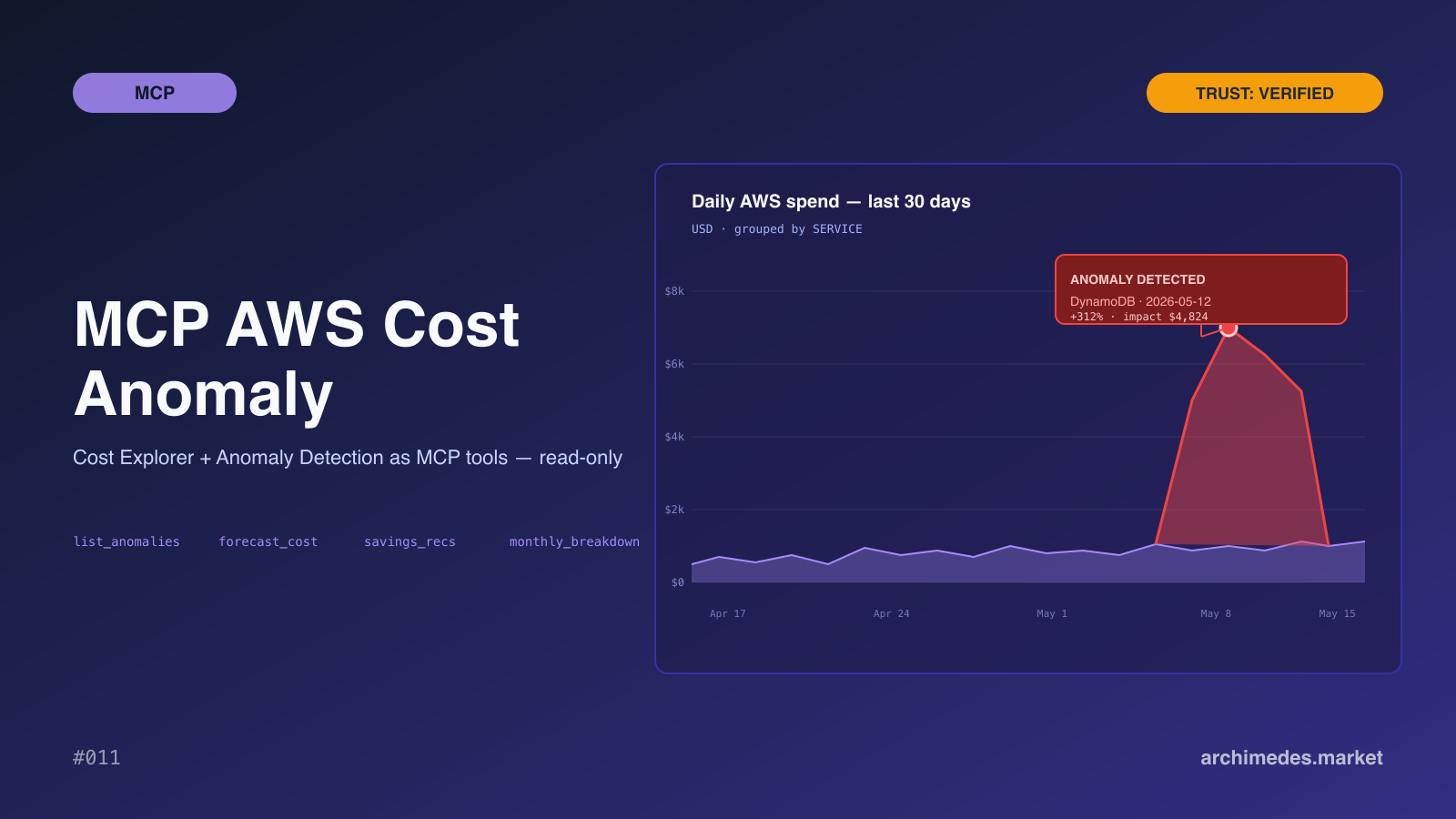
Curated by Archimedes Market. AWS Cost Explorer + Anomaly Detection exposed as MCP tools. Surface unusual spend by service, account, or tag. Pull cost breakdowns, forecasts, savings recommendations. Read-only IAM — refuses to start if the role can modify resources. → archimedes.m

irvinebroque

bryantanderson

rmavuluri

bydymainit2

chrisjpatty
chaandannn
Local-first FinOps copilot: ask about your AWS, Azure, GCP, and SaaS costs in plain English. Anomaly detection, rightsizing, idle-resource cleanup, and Jira/Linear ticketing, all in your own Claude. Credentials never leave your machine.

miltonian

bocchiczennie

sharma0vineet
MCP k8s server

KaiLongWu

alvinmrrry

hufeng03

wakeupworld

MFLS2023

zzerding

Azure-Samples
This is a quickstart template to easily build and deploy a custom remote MCP server to the cloud using Azure Functions with Java.

kentwalters

VerveMind

sergimiral
Common questions about MCP servers, tools, and integrations
An MCP server is a program built on the Model Context Protocol that wraps a tool, data source, or API — like file access, a database, or web search — into a capability an AI assistant can discover and call.
Every server's detail page includes ready-to-paste config snippets for Claude Desktop, Cursor, VS Code, and other common clients — most installs take just a couple of minutes.
Most servers listed here are free and open source. Some wrap third-party APIs (cloud services, paid data providers, etc.) that require your own API key or subscription.
A local MCP server runs on your device and usually connects over stdio, giving you more direct control over data but requiring a runtime and installation. A remote MCP server is hosted by a provider and connects over HTTP, making setup easier while adding network and provider availability dependencies.
Claude Desktop, Claude Code, Cursor, VS Code, Codex, and other AI clients that support the Model Context Protocol can connect to MCP servers. Configuration formats and supported transports vary by client.
Review the source repository, maintenance activity, dependencies, requested permissions, and data-handling documentation before installation, and prefer official or trusted maintainers. Use least-privilege credentials for sensitive access such as files, databases, shells, and production systems.